Harper Valley PTA/Fru Johnsen/Fr36ken Fredriksson
December 21, 2009, [MD]
It's incredible the stuff you can find on the internet, how everything is linked together. So I'm in our little apartment in Beijing trying to clean up before my wife comes back, and put on a collection of Norwegian 60's music which I have downloaded. The first song is cute, the story of some woman living on a little conservative place in Norway, and getting called to church by the "council for high moral", because she was wearing too low-cut dresses. But she ends up teaching them all a lesson.
I thought the song was cute, so I wanted to know more. I googled a line of the song, and found out that it was called Fru Johnsen (Mrs. Johnsen), and was written by Terje Mosnes and performed by the still famous Anne Lise Rypdal in 1967. Apparently it caused enough consternation that it was for a period banned from playing on the national broadcaster (lyric here, video here).
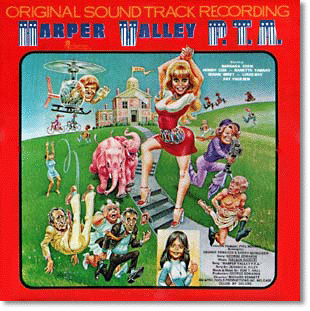 However, this song
wasn't original - in fact, it was an adaptation of a very well-known
American country song called "Harper Valley PTA" (Wikipedia
entry). This song was
written by Tom T. Hall, and performed by Jeannie C. Riley, but has still
been covered many times, including by Dolly Parton, and recently in an
episode of Desperate Housewives! The story is roughly similar, although
here our heroine is up against a small-town PTA (parents-teachers
association). One video is
here, lyrics
here.
However, this song
wasn't original - in fact, it was an adaptation of a very well-known
American country song called "Harper Valley PTA" (Wikipedia
entry). This song was
written by Tom T. Hall, and performed by Jeannie C. Riley, but has still
been covered many times, including by Dolly Parton, and recently in an
episode of Desperate Housewives! The story is roughly similar, although
here our heroine is up against a small-town PTA (parents-teachers
association). One video is
here, lyrics
here.
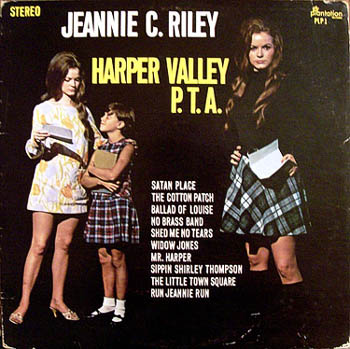
But, we're still not done! Because according to the Wikipedia-entry above, it was also adapted into a Swedish version, called Fröken Fredriksson (Ms. Fredriksson). I think this was originally performed by the Hootenanny Singers (a Swedish group), but later it was covered by the well-known ABBA. In this song, the story is quite different - the young unfortunate miss is seen watering plants in a nightie that is opened by the wind. Shocked by this sight, her busybody neighbor begins spreading rumors, and Fredriksson eventually has to leave town - right after calling out her neighbor as a hypocrite. The song can be heard here, and the lyrics are here.
It's a fun song to listen to, and it was a fun story to unravel. I love
the ability of the Internet to bring together many different cases, and
analyze them together. When the song came out, probably few in Norway
had ever heard the "original", and if they wanted to listen to it, they
would depend on it being offered for sale in Norwegian record stores.
Now, it just takes a few minutes to find
it.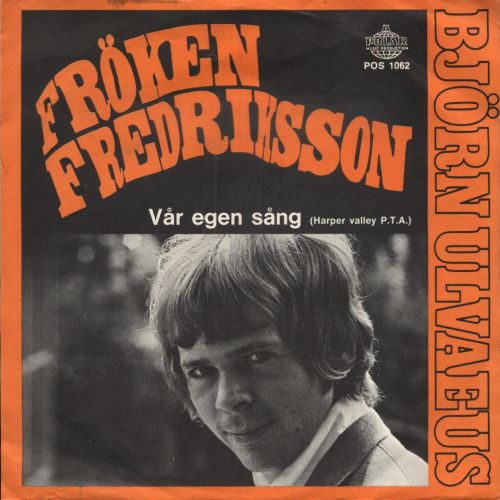
It's also interesting how the versions differ. I listened to a lecture at the University of Oslo once, by an anthropologist who also played in a punk rock band, he had spent time researching the punk culture in Korea. He made the point that by looking at what the songs protest against, you can learn something about the culture. In England and the US, the songs are often against the "system", the "man", the government, the police. In Korea, it was more often against ones own parents, and the schools.
Thus, in the Norwegian version, the church is the oppressor, but in the US, it's a more generalized small-town oppressiveness. And the Swedish one (if it's really a remake, you can't always trust Wikipedia), it's common people's pettiness. However, that's also the saddest one, because in the other two, the protagonist gets the upper hand in the end, and "shows them all", whereas in the Swedish, she is still forced to leave town.
Update, I found a version from the film/tv series that was built on the song:
Listen and enjoy.
Stian
Stian Håklev December 21, 2009 Toronto, Canada comments powered by Disqus