Online conferences, teaching and learning in Second Life, SLanguages 2008
April 3, 2008, [MD]
 Hybrid
models\
The new tools available for connecting us and sharing text, video and
audio has made it possible to put online many of the interactions and
events that used to require moving many people physically to the same
place. There are many ways of attempting to do this, more or less
successfully. I think hybrid models which mix online and “meatspace”
interactions have a lot of potential for maximizing the value of time in
meatspace, for example. When I first went to
iSummit in Dubrovnik in 2007, I was
very interested in participating in the education track, which featured
a lot of breakout groups, a ban on PowerPoint, and very intense
facilitation (by for example the amazing
Gunner). However, I had
never had a chance to hear luminaries like Jimmy Wales, Cory Doctorow
speak Yochai Benkler live before, and I decided to go to some of their
sessions instead of the education ones.
Hybrid
models\
The new tools available for connecting us and sharing text, video and
audio has made it possible to put online many of the interactions and
events that used to require moving many people physically to the same
place. There are many ways of attempting to do this, more or less
successfully. I think hybrid models which mix online and “meatspace”
interactions have a lot of potential for maximizing the value of time in
meatspace, for example. When I first went to
iSummit in Dubrovnik in 2007, I was
very interested in participating in the education track, which featured
a lot of breakout groups, a ban on PowerPoint, and very intense
facilitation (by for example the amazing
Gunner). However, I had
never had a chance to hear luminaries like Jimmy Wales, Cory Doctorow
speak Yochai Benkler live before, and I decided to go to some of their
sessions instead of the education ones.
After a while I realized that because I had been watching many of their talks online earlier a) many of their ideas weren’t that new, b) I could just as well watch them after I got home from the conference. In addition, for me who knew nobody and wanted to get to know people, these sessions were not conducive at all. We sat several hundred people in a room, listened to a panel, asked a few questions, got up and left. On the other hand, in the education sessions, we brainstormed topics, sat in small groups and had intense discussions developing our thoughts. Then we went and had lunch together afterwards. The group discussion I had with Philip Schmidt and Neeru Paharia on the p2p university still shapes how I think about key questions around open learning.
 In
a world where flying is becoming viewed as more and more of an
environmental problem, it’s crucial to intensify the experience when
face2face, and save the rest for online. When I participated in the Open
Translation Tools conference in Zagreb (facilitated by, not
incidentally, the same Gunner), we spent an intensive five days
communicating without stop - interactive, in small groups, shaped by the
participants - unconference-like. We exchanged so much information,
developed strong relationships, and new ideas, and arrived at
conclusions and a way forward as a group. This is stuff that would have
been much harder to do online. Flying to Zagreb for five days of
PowerPoints would have been a complete waste.
In
a world where flying is becoming viewed as more and more of an
environmental problem, it’s crucial to intensify the experience when
face2face, and save the rest for online. When I participated in the Open
Translation Tools conference in Zagreb (facilitated by, not
incidentally, the same Gunner), we spent an intensive five days
communicating without stop - interactive, in small groups, shaped by the
participants - unconference-like. We exchanged so much information,
developed strong relationships, and new ideas, and arrived at
conclusions and a way forward as a group. This is stuff that would have
been much harder to do online. Flying to Zagreb for five days of
PowerPoints would have been a complete waste.
The same thing can apply in academia. Mark E. Ott teaches physics, and he records his lectures and assigns the videos to his students. Instead of recording two hour chunks, as if he was in a classroom for two hours, he records smaller chunks of ten minutes, so that if students want to go back and review a segment, they can choose only that specific segment. He then spends the two hours he freed up of teaching time to supervise students who are working in groups with projects. This sounds to me like a much more productive way of using his time.
 Entirely
online\
When it comes to events or processes conducted entirely online, I would
argue that the way they are conducted needs to be fundamentally
rethought to fit the medium, rather than to try to do the same as we did
offline, only online. In fact, much of what we did offline - for example
cramming 100 people in a room to listen to a lecturer for two hours,
might not have been because we thought that was the ideal way of
teaching/conveying knowledge under ideal conditions, but because of
historic, spatial, temporal and economic limitations particular to the
physical space. For example, it is hard to gather 100 people at the same
time, so we have to teach them for a few hours to make it worth their
while, etc.
Entirely
online\
When it comes to events or processes conducted entirely online, I would
argue that the way they are conducted needs to be fundamentally
rethought to fit the medium, rather than to try to do the same as we did
offline, only online. In fact, much of what we did offline - for example
cramming 100 people in a room to listen to a lecturer for two hours,
might not have been because we thought that was the ideal way of
teaching/conveying knowledge under ideal conditions, but because of
historic, spatial, temporal and economic limitations particular to the
physical space. For example, it is hard to gather 100 people at the same
time, so we have to teach them for a few hours to make it worth their
while, etc.
David Wiley’s course on Open Education last term was a great example of changing the format to suit the medium. Instead of recording himself speaking for two hours, and letting us view that on a tiny window on our screens pretending we were sitting in a lecture, he assigned readings on his wiki, and had us read and post our reflections on our own blogs. We then read our classmates blogs (most of which are still available, my postings are under the open-education label on this blog for example), and commented. He’d often chime in in the end with a summary and pulling the threads together, before we went to the next week. A very different format from a bricks-and-mortar class, but one that (with minor hiccups) worked remarkably well, and was by most accounts a remarkable learning experience, with very little overhead.
The Higher Ed Blog Conference 2006 was also reworked completely. Presentations were posted each day over four weeks, with specific topics, however the presentations were not given live, but recorded - sometimes just an mp3, sometimes a slideshow with an mp3, or a video, etc. Participants could view these at their leisure and participate in the discussions that formed around them. I am sure there are many ways to improve on this model, but it fit my busy schedule, and I learnt a lot from being part of that ‘virtual learning community’ for a few weeks. Making both learning and sharing of knowledge events (conferences) available online is a great way to extend participation both geographically and economically (I am very interested in a topic, and might have useful insights, but I don’t work for an institution that can fly me around the world and pay hundreds of dollars in conference fees).
** Second
Life - imitating meat space online?\
**Second Life has been around for several years, and I have tried it out
a few times - since I keep hearing people talk about it. At iCommons in
Dubrovnik there was even a panel session on using it for education, and
there have been many experiments conducted and papers written on the
various aspects of SL. I just never got it (and maybe that should make
me feel old). I’ve logged in a few times, walked around, teleported here
and there, and not found it that exciting, despite the fact that I can
spend hours traversing blogs, chatting, Skypeing, and using different
kinds of interactive websites. I remember thinking when iSummit in
Dubrovnik was streaming live in Second Life - what is the advantage of
doing this, to streaming it on a website? (Except for the fact that they
can display on a big screen TV in Dubrovnik the “avatars” participating
virtually). As a non-casual user of SL, I would find it a big hassle to
have to log into a big application, and teleport around until I found
the screen where I could stand and watch the streaming sessions, instead
of pasting a URL into a browser that a friend sent me, and watch it in a
tab. I am assuming that it also requires a lot more processing power and
internet connection than a simple audio stream for example, which is
quite relevant to how accessible this is to the entire world.
Second
Life - imitating meat space online?\
**Second Life has been around for several years, and I have tried it out
a few times - since I keep hearing people talk about it. At iCommons in
Dubrovnik there was even a panel session on using it for education, and
there have been many experiments conducted and papers written on the
various aspects of SL. I just never got it (and maybe that should make
me feel old). I’ve logged in a few times, walked around, teleported here
and there, and not found it that exciting, despite the fact that I can
spend hours traversing blogs, chatting, Skypeing, and using different
kinds of interactive websites. I remember thinking when iSummit in
Dubrovnik was streaming live in Second Life - what is the advantage of
doing this, to streaming it on a website? (Except for the fact that they
can display on a big screen TV in Dubrovnik the “avatars” participating
virtually). As a non-casual user of SL, I would find it a big hassle to
have to log into a big application, and teleport around until I found
the screen where I could stand and watch the streaming sessions, instead
of pasting a URL into a browser that a friend sent me, and watch it in a
tab. I am assuming that it also requires a lot more processing power and
internet connection than a simple audio stream for example, which is
quite relevant to how accessible this is to the entire world.
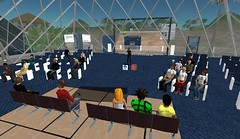
What prompted me to write this entire post was actually coming across the website of SLanguages 2008, a virtual conference on language learning in virtual worlds. I am very interested in language learning and how collaborative technologies might improve and facilitate that, however I wondered how efficient it would be to have a conference in SL, and how that would be different from just utilizing standard Web 2.0 technologies. The picture I posted above - from last year’s conference, gave me pause. For the best of me, I cannot imagine why one would want to construct an elaborate virtual 3D world, just to install a number of benches and have people sit and listen to someone speaking up front. Are we that nostalgic of the huge lectures of yesteryear? Are there not better, more intense and inclusive ways of facilitating teaching, learning, discussion and knowledge sharing online? I would probably have been more likely to participate had I not had to go into this virtual world to do it (then again, I realize this is about Virtual Worlds, and I appreciate them drinking their own Kool-Aid, but I’ve seen similar things in SL before, so the general argument still stands).
 Perhaps
SL is brilliant, and I just haven’t seen it yet - certainly I am very
appreciative of people experimenting with all kinds of only delivery and
facilitation, from this to the new course in Wikiversity on Composing
OERs
which is partly inspired by David Wiley’s course. What I really hope is
that they all endeavor to evaluate and document, do action research,
write it up, share it - so that we can together discover new ways of
communicating.
Perhaps
SL is brilliant, and I just haven’t seen it yet - certainly I am very
appreciative of people experimenting with all kinds of only delivery and
facilitation, from this to the new course in Wikiversity on Composing
OERs
which is partly inspired by David Wiley’s course. What I really hope is
that they all endeavor to evaluate and document, do action research,
write it up, share it - so that we can together discover new ways of
communicating.
Stian\ Thanks to Martin_Heigan,Last Exit ~,Dean Terryt, r-z and blogefl for the pictures.
Stian Håklev April 3, 2008 Toronto, Canada comments powered by Disqus